I Think in Blue
On color, recognition, and what the body knows first.

"We don't get to choose what or whom we love. We just don't get to choose.”
Maggie Nelson, Bluets
My living room is blue. I knew before anything else, before measuring the walls or thinking about furniture or asking anyone, that it would be blue. I did not choose it so much as recognize it, the way you recognize something that was already true before you had language for it.
The kitchen cabinets too. The entrance is red, a particular and unapologetic red, the kind that alters your step as you cross into it. I wanted that feeling, the sense of entering somewhere else, something closer to a cabaret than a hallway, a place where the light is different and the rules might shift slightly. I hung an old Louis XIV mirror there to catch whatever comes in. Arrival, I thought, should feel like arrival.
When I finally did ask a professional, a color consultant who spread swatches across the table and read the light in each room before speaking, she guided me gently toward restraint. Pigeon for the staircase, Mizzle for the closet, Lime White for the landing where the skylight opens up. They were beautiful, quiet and composed, and I was grateful for his eye. But I noticed, even within that guidance, that I kept circling back to the same gravitational field. Pigeon is a grey that leans toward blue, that cannot quite resist it, and neither, it turns out, could I.
Children ask the question all the time, as if it were simple. What is your favorite color. They answer it without hesitation, without irony, without trying to be interesting. When I was choosing paint, they had opinions about everything. Martina would chose green for one of the rooms. I painted it green. Then others would say this one feels calm, that one is sad. Their logic made sense to me immediately, not because it was correct, but because it was felt. No one had taught them that colors carry anything. They were already speaking the language.
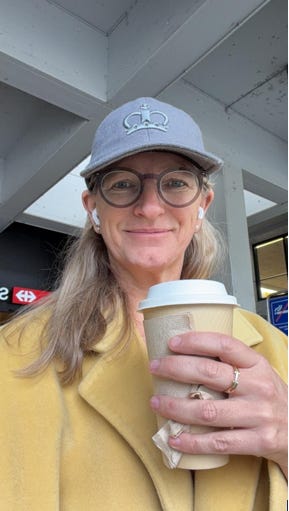
There was also a yellow period. I stood in front of swatches for weeks, seriously considering painting the upstairs in yellow, not a diluted version but the real thing, full and insistent. In the end I moved toward olive and beige, colors that would not insist too loudly on themselves. But something in me kept trying. That winter I bought a yellow coat.
I wore it to the office one day last week. People noticed. Not about work.
I came home and started writing about color, and halfway through I realized I already had, again and again, without ever naming it as a project or a preoccupation or even a pattern.1
I had been returning to it without naming it, as if the color itself had been doing the remembering while I was busy writing about other things.
I used to tell people I had blue eyes. I do not. They shift and refuse to settle into one thing, but they are not the blue I always wanted, not that particular depth I had assigned to myself without evidence. Reading Maggie Nelson this week, I lingered on the question she poses about whether blue eyes see the world differently, whether the eye that holds a color is changed by it. She suspects not, then allows herself to believe it anyway, flagging the belief as self-aggrandizement and proceeding regardless. I understand that impulse more than I would like to admit.
Goethe wrote that we love to contemplate blue not because it advances toward us, but because it draws us after it. Blue does not come to meet you. It beckons, and you move. And in that movement, somehow, I find I am held. There is a lightness inside that holding, something that functions simultaneously as ground and lift, and I feel it in the living room every morning before I have done anything else.
Language keeps reaching for color when it runs out of precision. In English a bad day is blue, and the origin of that phrase is genuinely uncertain, possibly sailors flying blue flags when a captain died at sea, possibly something darker, possibly simply the human need to name a state that resists all other description. In German, Blau machen means to go absent, to disappear from obligation for a while, to make yourself blue in the sense of making yourself gone. Every language arrives eventually at color when ordinary words stop being sufficient. That is not decoration. That is color doing something language cannot hold.
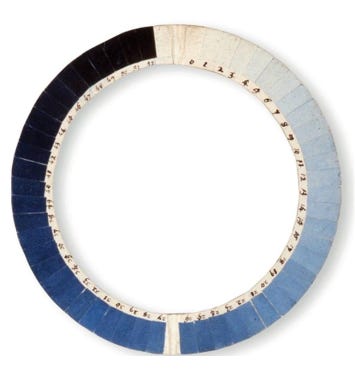
Horace Bénédict de Saussure, the Swiss naturalist, attempted in 1789 to solve this problem with what he called a cyanometer: a circular card with 53 numbered swatches of blue arranged in gradations from pale to deep, with the center hollowed out so you could hold the absence up to the sky and find where it fell on the scale. What strikes me about this instrument is not its ingenuity but its tenderness, the faith that correspondence was possible, that blue had positions you could locate and name. You do not measure blue by filling it in. You measure it by holding an absence up to it and seeing what surrounds the gap. It did not work, of course, or rather it worked only as well as any act of translation works, which is to say imperfectly and beautifully and not quite enough.
Nelson describes standing in front of Yves Klein’s blue paintings at the Tate in London and writing only two words in her notebook: too much. She had traveled a long way to see them and could barely look. I recognize that. I cry when light is too strong, not from sadness but from something closer to overload, the sensation of color arriving faster than the nervous system can process it, contact without permission. There are moments when color feels less like something we perceive from a distance and more like something that simply enters us, whether we were ready or not.
Lately I have been looking for a dress for a party, the kind of search that begins casually and then, without warning, becomes clarifying. One possibility is soft and long, almost Mediterranean, the blue of open water and moving air. The other is electric and close-cut, approaching Klein’s intensity, the kind that risks being too much. I have not decided yet which one, but I already know that it will be blue. That part was never in question, and I see now that it never really could have been.
I don’t know yet what to do with all of this except to stay with it and keep writing about color, about what it carries, what it seems to know about us before we can articulate it, what we reach for when language arrives too late. The body, I am becoming more convinced, understands these things first. The mind organizes afterward and calls it a choice.
The living room is still blue. The coat is still yellow. I am still somewhere between the two.