
THE INVOLUNTARY SMOKER
Notes on air, intrusion, and the quiet persistence of other people’s habits

I have been trying to write a smoker.
Su nombre es Margarita. Es colega, no íntima, y viene a mí con algo urgente, algo que la asusta. La última ceniza del cigarrillo se le cae entre las tetas y la sacude soplando un poco, después suspira. Le alcanzo el encendedor eléctrico del auto porque hoy es la primera vez que dejo a alguien fumar en mi coche. Me desagrada. Pero Margarita está en un estado. Tiene información que necesito.
The scene works because of the cigarette. The pause before she speaks. The ash that falls with a kind of intimacy – between the breasts, between sentences. A cigarette in a character’s hand is already a sentence. It gives her time to not answer. It externalizes nerves without requiring me to name them. This is why every writer eventually gives someone a cigarette. It costs almost nothing on the page and it does almost everything.
So there I was, writing a smoker I understand instinctively as a character, while outside my actual window a neighbor was smoking on their balcony, the way they do every evening around seven, and the smell was already inside before I noticed the window was open. This happens often enough that I’ve learned to keep it half-closed at certain hours – not fully, because then there’s no air at all, and the alternative to someone else’s smoke is no air, which is its own problem. I live inside this negotiation.
On the running path, I’ve started studying them. Not with the grimace I usually reserve for when nobody’s watching. More clinically, now that I’m building characters who smoke: the way the hand lifts with a particular economy of movement, the long exhale that seems to reorganize the face, the specific ritual of finishing – the tap, the turn, the small decisive gesture of extinguishing something. The body, doing what it has learned to need. I am taking notes. Margarita requires it.
I grew up inside the smoke. My entire family, aunts, uncles, parents, the whole Argentine apparatus of adults assembled in rooms where the air was already used. I don’t remember what they were saying. I remember wanting to leave. The body learns certain things before language arrives to explain them, and what mine learned was: something is entering that should not be entering. That knowledge has never entirely left.
In Syria the air was collective in a way I wasn’t prepared for. Everyone inside the same cloud, at dinner, in offices, in cars, in corridors – smoke as the medium through which conversation moved. In Argentina it belongs to the night the way wine does, unhurried, structural. In France the cigarette is philosophy: it makes the table yours for another twenty minutes, it is the right to linger made visible. Each place has its own grammar for the same sentence.
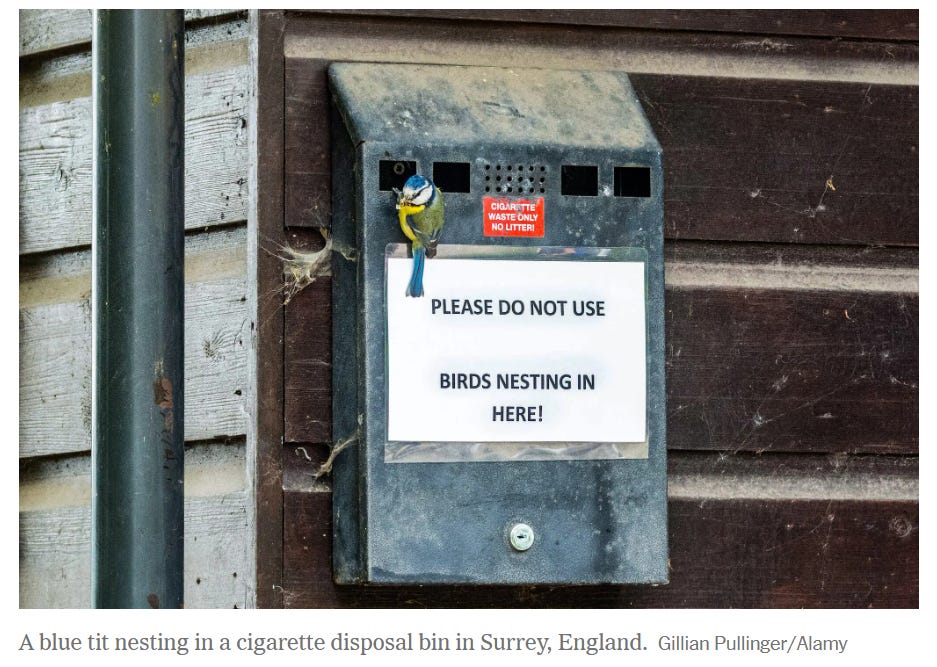
Research out of Poland, Mexico, the Galápagos: blue tits nesting in outdoor ashtrays. Darwin’s finches dismembering cigarette filters and weaving the fibers into their nests. House sparrows in Mexico City incorporating eight, ten butts on average – and when researchers added live ticks to the nest, the females responded by adding more cigarettes. It turns out the toxins ward off parasites. The birds have done the math. They are not addicted, exactly – they are self-medicating, or nest-medicating, which is either very clever or a perfect metaphor for something I don’t want to name directly.
One researcher, a non-smoker, had to mechanically smoke cigarettes with a bellows to conduct the experiment. He described it as the most challenging part of the study. I believe him. Another detail: nestlings in the butt-nests showed evidence of genetic damage from the exposure, long-term impacts unknown.
The birds are smart, said the lead researcher, without apparent irony.
I have friends who smoke. Good friends, people I love, people whose company I choose deliberately. I hand over lighters without commentary. I open windows in the direction that helps. I say nothing, or almost nothing, because the friendship is worth more than the position, and because I understand, in some animal way, why a person reaches for something the body has learned to need.
When I write in Spanish I talk to Martín Caparrós. Not literally. But I ask myself whether I can be as honest as he is, as unadorned. He is Argentine, magnificent, one of the great journalists writing in the language, and he has smoked his entire life. Now he has ALS and he is still writing, which surprises nobody who has read him. I have no idea what smoking gives him – relief, rhythm, something to do with his hands between sentences, a small reliable pleasure in a life that has not always been small or reliable. I don’t know. I never asked. I only know I cannot turn it into a lesson, because he would tell me that’s a very boring thing to do with a cigarette.
So I don’t know. I take notes on smokers in the park. I keep the window half-open. I write Margarita into the passenger seat of my car and hand her the lighter because she’s frightened and she has information I need.
You light it. I inhale it.
The window stays closed.
Beautiful writing.
Did you know that, for reasons unknown, smoking reduces the risk of developing Parkinson's disease? (Though of course the harms vastly outweigh that benefit.)
Beautifully written as always
I was a very heavy smoker until ten years ago so I see both sides of this. I'm an anxious, addictive person so I was never without a cigarette in my hand! But since I've stopped what my lungs and nostrils had tuned out is so apparent to me! I now completely understand how invasive it is for non smokers.
The stuff about birds is fascinating though saddening