
Too Generous
Three drops, not six: Notes on appetite, taste, and a cooking class in Geneva

On a kitchen in Geneva, Brillat-Savarin in 1825, and Mallmann in New York
The room
Fabrice gave me a gastronomic cooking class for my birthday. The gift was to do something fun together, to learn a thing or two about cooking and, of course, to eat. He is the pâtissier of our kitchen. He makes brownie cookies with tahini ice cream and bakes the most delicious chocolate Guinness cake. He had done a cooking class once before which he remembered fondly enough to want to do another with me.
The website sold the class as Michelin. It named Serge Labrosse, the chef, and his brigade. It used the words precision, elegance, haute cuisine. It offered “une expérience immersive pour les passionnés désireux de sublimer leur savoir-faire culinaire” and a menu that was not the one we cooked.
We arrived on time, 18h30. A few other hopefuls were already there having an apéro. More continued arriving, and that is when I started noticing that the room was small. Truly small. To fit the twelve of us at the prep stations they had added high tables along the side of the bar.
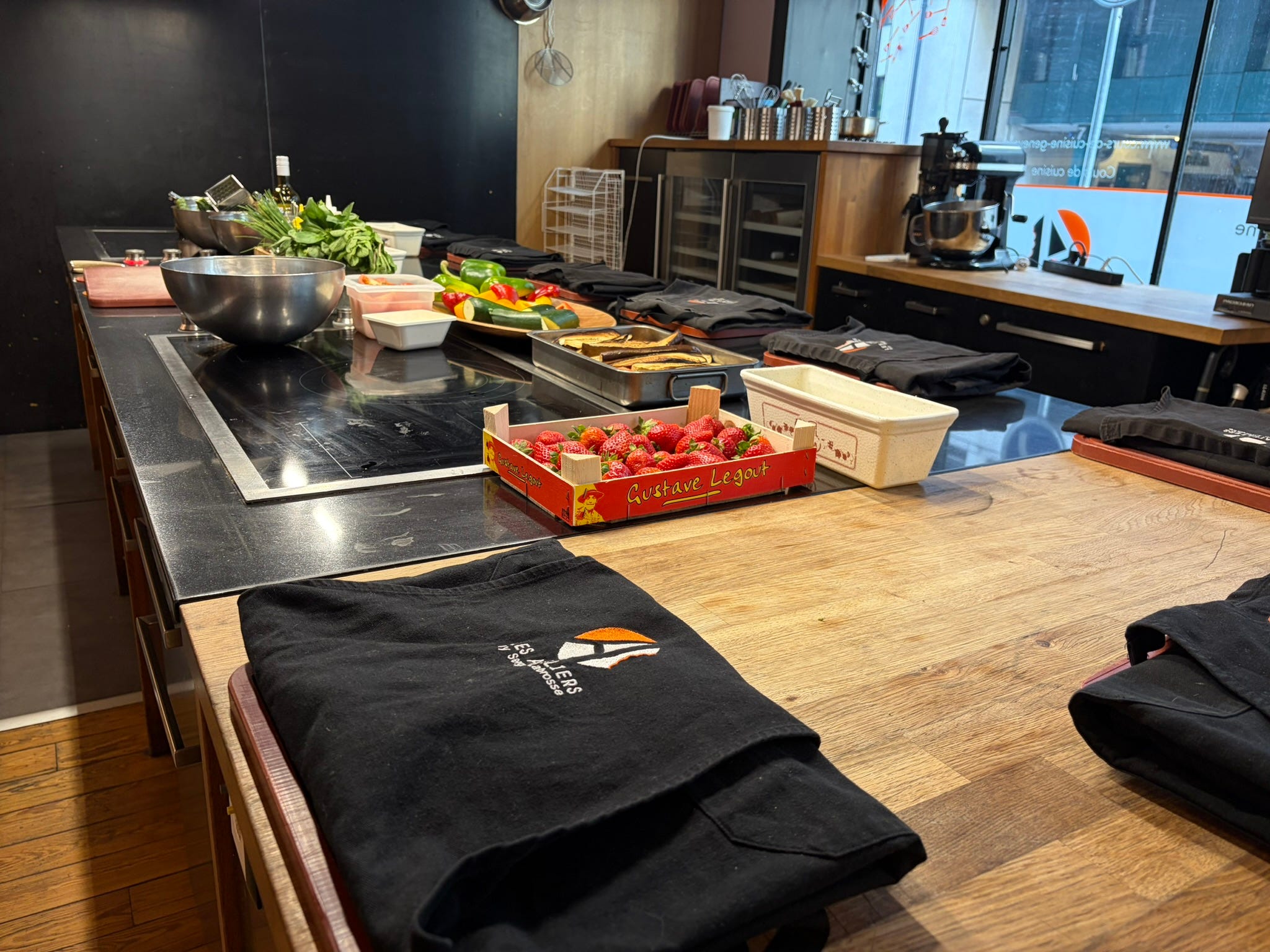
The decoration was thin and old and the kitchen tools were worn out at the handles. Nothing matched. Not the kind of mismatch that someone has chosen. On the counter there were black aprons folded in stacks, embroidered orange and white with the school name. Behind them a wooden crate of strawberries with the words Gustave Legout printed across the side, so red against the dark countertop that for a few minutes I believed the school’s own description of itself. Basil, parsley, chives in a steel bowl. Loaf tins. Pepper halves. The bowls were lined up along the back. The induction surface was clean. It looked, for a few minutes, like the language on the website.
Fabrice had clocked the gap before I had. He was glancing around with the small attentive face he uses when he is comparing what is in front of him to something he has done before. He did not say anything yet. He was being polite to me, who had been excited.
Then the class started and the place became what it was. Crowded. Loud. Improvised. Behind us the old fridges hummed all evening. We kept bumping elbows while cutting.
The woman teaching was alone. She cooked, explained, divided us into groups, monitored the heat, corrected our knife work, saved dishes before they collapsed, plated, and later, while the rest of us sat at the long table eating what we had made, she cleaned. The class was sold as Michelin. What walked in was a working cook with no help.
What she taught
She taught me about the casserole.
Not the expensive frying pan I bought when I started taking my own cooking seriously. A casserole. Heavy, deep, a lid that traps. The vegetables went in cut into three or four centimetre pieces. Courgette, cucumber, celery, white onion and poivron. A little colza oil, salt, the lid on. At first the smell was nothing. Pale, wet, almost steam. Don’t stir, she said. Don’t open. Let the water leave.
I stood next to Fabrice at the bench. He was cutting cucumber into small cubes, slowly, evenly, the knife moving forward in the way she had told us to move it. The cucumber smelled bright and wet at every press of the blade. He cut faster than I did and looked less like a beginner. At one point he murmured, in his low French, ce n’est pas terrible. He did not repeat it. Later in the evening I would overhear him say, to no one in particular, that the colleagues of the chef had told him during the apéritif that they were about to sign for a bigger space nearby. The chaos in the room, he said, was the chaos of a business outgrowing itself. I stored the information without yet knowing what I would do with it.
After a while the smell deepened. Warmer, browner, vegetal in a way roasted vegetables are vegetal. The sound shifted too. The light tic-tic of moisture became a heavier rhythm, the bottom catching. That was the moment. You stir once, you let the underneath colour, then you stop again. The vapour from below rises, hits the cooler lid, falls back as droplets onto the top of the vegetables. So the bottom caramelises and the top steams. The pan, she said, only colours. The casserole cooks both ways at once.
She was strict about the olive oil. Not to cook, less to ‘rotir’. At the end, use it to finish. Use it where it sharpens. Don’t drown the vegetables in it before they have had a chance to taste of themselves. Start at low temperature, with the vegetables on top of the oil and the gros sel. You don’t stir. You wait, then you stir. You do this four times. Let the vegetables sing …
Then the tomato sauce. At home the sequence is old and almost involuntary. Onion, then tomato, then garlic, then patience. Here she did something else. Two tablespoons of sugar straight into the dry casserole. She set the casserole on the heat with the sugar at the bottom, and one or two of us drifted over to watch. The sugar sat there, white and granular, for what felt like a long time. Then the edges started to dissolve. The whole surface went wet, then translucent, then yellow. The smell rose, hot and sweet, the smell of caramel before it goes too far. By the time the colour deepened to the pale brown of an almond skin, every voice in the room had dropped. Even Fabrice, who had been peeling something at the next station, was leaning in. She lifted the casserole, dropped a bowl of chopped tomatoes onto the caramel, and the room hissed. A column of steam climbed to the lamp. The tomato juice broke against the sugar and dissolved it. The sauce that came out of that collision had a darker note underneath the brightness, the same note you taste in restaurant sauces and never quite place. There was no mystery in it. There was caramel, and there was sequence, and that was the whole trick.
She was as careful about the cutting as she was about the heat. Brunoise was not there to keep us busy. If you crush vegetables instead of cutting them, the juice runs out, and the juice carries the taste. People complain that a dish has no flavour, she said, when the flavour was lost before they sat down. The knife moves forward, never down. One man in our group, tall, who had quietly appointed himself keeper of the wine glasses and observer of the chicken, kept hacking. His herbs came out bruised, the basil already darkening at the cut. He was generous with the wine. Less so with the cilantro.
The chicken was the cold start. Skin side down in a cold pan, same process: oil and salt. Slowly the fat extracts. The skin colours from below, evenly, not in a hurry. Once it has a real crust you turn it, briefly, and finish in the oven, which by the time the meat goes in is already coming down from two hundred. Most people ruin chicken by getting involved too early. The lesson, she said in different ways all evening, is to stop poking. Stop correcting. Let the surface form before you ask it to do anything else.
The asparagus came next. Green and white, the white peeled in long pale ribbons that fell into a heap by her elbow. She sautéed the brunoise of the bases quickly, kept them with a little bite, then let them cool. The strawberries went in last, diced the same size, glossy and red against the pale yellow and pale green of the asparagus. The base of the dish was a panna cotta she had made earlier from puréed white asparagus, cream, milk, a little gelatine, set in shallow terracotta bowls. Pale. Dense. Almost milky white. Around the rim, dots of a herb sabayon, eggs whisked over a bain-marie with a coulis of basil and mint and spinach in place of the usual butter.
The first spoonful went in cold. The panna cotta was colder than I expected, cold like a custard that has been in the fridge since morning. The taste was vegetal in a way milk is not supposed to be, the asparagus translated into cream, almost grassy, almost flowery, holding onto the small bitterness of the stem. The brunoise on top was at room temperature, with the bite still in the asparagus. The strawberry, as I lifted the spoon, looked at first like a mistake. Red against pale green and white, too sweet, too obvious, the wrong fruit at the wrong table. The bite changed that. The cold cream of the panna cotta hit first, then the asparagus warmed against it, then the strawberry undid the green. Underneath everything was the eggy edge of the sabayon, sharp at the centre, herbal at the edges, smelling faintly of cut lawn and chlorophyll and something like the younger cousin of a sauce gribiche. The whole thing was not an idea about flavour. It was flavour.
I was given the plating bench. Six terracotta bowls were laid out. I started building. Pale cream in the centre. Brunoise on top. Sabayon around. I worked carefully, I thought. When I was halfway done she came over and said, gently, you understand there are twelve of us. There were six bowls in front of me. I had built them as if they were three. The truth is that what was left in the panna cotta tray would not have stretched to twelve. I had been generous, and the generosity had cost. With the sabayon I was supposed to put three drops on each bowl. I put six. Round, fatty, ugly drops, the kind that pool. Fabrice came over to look at what I had done and said tu es trop généreuse. He meant it as a diagnosis.
I cannot plate. It isn’t a question of art. It is something else, something underneath the art.
I cannot follow a recipe either. I read them, I take what I want, I add what I have, I cook for too long, I swap meat for meat, I keep adding. I make ragù with four kinds of meat in it, including tongue. I cook the meats in a stock I have made the day before, a trick I saw Massimo Bottura do once and decided I needed. I have never followed a cookbook from start to finish. Every recipe in my house has been revisited. The Italian word for it is revisitato, the French revisité. The honest English word is I cannot leave anything alone. The honest underneath word sits closer to hunger.
We will get to that.
Brillat-Savarin
Brillat-Savarin found me late. Or I found him late. I had bought the book years ago and not read it. I bought it again recently because of the sequence of essays I am writing now, and this time I read it as if he had been waiting there, mildly amused, the whole time.
Brillat-Savarin found me late. Or I found him late. I had bought the book years ago and not read it. I bought it again recently because of the sequence of essays I am writing now, and this time I read it as if he had been waiting there, mildly amused, the whole time.
He was a lawyer from Belley. He fled the Terror. He spent time in America and played the violin for money. He went back to France, returned to the law, and wrote The Physiology of Taste in the spare hours of a life that had already seen enough upheaval to make pleasure feel either frivolous or essential. He chose essential. He took the same exacting attention to the table that he had taken to the bench. He defines taste, names its organs, insists on the cooperation of tongue, palate, cheeks, and nose. He writes about truffles, appetite, gourmandism, indigestion, memory. He quotes the man he met in Amsterdam whose tongue had been cut out and who could still taste mild flavours but not acid or bitter ones. And then he writes the sentence that explains why he belongs here at all: Tell me what you eat, and I will tell you what you are.
His sister Pierrette died at one hundred, sitting up in bed, having just finished dinner and calling loudly for dessert.
I read him as if he were answering me. The body that had survived a Revolution wanted to know exactly what it was tasting and why. There is no frivolity here. Joy in a century of terror is also a serious matter.
That gets you into him faster and keeps the best details.
Memory
I cannot remember my first Michelin restaurant. I have spent hours trying. I went through credit card statements for years backwards, reading expenses like archaeology, trying to reconstruct from the names of villages and amounts in different currencies which evening it was. I remember my first kiss. I remember my first real heartbreak. I remember the first time I thought, in French, putain, this is no life. I do not remember the first time someone put a small precise plate in front of me and the room went quiet for the duration of the bite.
It bothers me. Not remembering food is an offence I cannot easily forgive in myself.
In the end I found it. Mirazur, Menton, June 2017. The rented car nearly didn’t make it. Somewhere between Èze and the border the GPS sent me up a road too narrow for the car and far too steep to back out of, and I sat there for some long minutes with the engine off, the smell of warm metal and dry herbs coming through the window, calculating whether to ring the restaurant or try to inch backwards down a slope I was already certain I would not survive in reverse. I did inch back, very slowly, the handbrake working harder than the engine. I arrived at noon. I sat alone at a table by the window. They poured me a glass of rosé Champagne, Billecart-Salmon, and I have not had a glass like that since, though I have probably had glasses that someone else would have called better. The room smelled of polished wood and lemon and the sea below. The chef was Mauro Colagreco, Argentine, who had quietly become one of the most important cooks in Europe. I drove away in the late afternoon with the windows down and the feeling that something inside me had been answered before I had known how to ask the question.
I went back many years later with Fabrice. By then Mirazur had three Michelin stars and the dining room had developed performance habits. A waiter brought a long lacquered tray to our table before lunch with a pumpkin and beets and herbs and a bunch of carrots leafy at the top, and explained that these were the vegetables we would be eating. Look at this beautiful pumpkin. We were meant to admire it. We did. We looked at the pumpkin the way we were being asked to look at the pumpkin, and then we looked at our food when it came in the same way. The promise broke somewhere between the wooden tray and the plate. It is hard to taste anything once you have been told what to feel about it.
I have a friend who once said about both of us, we grew deprived. She did not mean money. She meant that nobody in our families taught us how to enjoy. That the language of pleasure, of refinement, of taking time at a table, was not spoken at home. She put it in Spanish, impensado para nosotras, unthinkable for us, and added, eso es algo argentino. Then immediately, no, no lo es. It is something more.
It is something more.
The snobism that grew in me from this is real, and I do not feel any need to defend it. I love where it came from. It came from a girl who suspected, without knowing how to name it, that there was a way of being at a table that her own kitchen had not been able to teach her, and who set out, slowly and expensively, to learn. Food, restaurants, cookbooks, status, guilt, hosting, memory, bodies, money. All of these became one of the ways I have been trying to educate desire without ever fully escaping hunger.
I do not know yet whether you can educate the one without escaping the other.
Appetite
As I write this my stomach hurts. I am not good at eating when I am alone. There are things I do that are not good for me, and that I had thought I had outgrown. They come back, mostly when no one is in the room.
The night before I started this essay I ate a quarter of my own birthday cake. Dulce de leche and cream. There is a Natalia Oreiro line in an Argentine telenovela of the nineties, where she calls this kind of eating angustia oral, oral anxiety, the way the body tries to put something in the mouth in place of what it cannot say. She said the line beautifully. She did not look like a woman who ate quarters of cake alone. Or perhaps she did and we never knew. On a different spectrum, Lena Dunham in Famesick tells the moment a colleague on set told her she had got too thin to play her own character: it’s not that hard. Just put food in your mouth. Said by one woman to another woman whose body had been scrutinised by strangers for a decade. As if the body always knew what the answer was, and only the will was the problem.
This is a difficult relationship. I will not pretend to be past it. I will also not perform the breakthrough. I am still inside it. I have learned what to call it. Calling it something has not made it stop.
What Michelin restaurants offered me, and what I have used them for without saying it plainly enough, was a form of excess with cutlery, order, and a wine list. The room is quiet. The bread arrives warm. The plates are small, precise, expensive enough that leaving food behind feels almost rude. Someone else decides when the next thing comes, and how much of it, and with what sauce, and in which glass the wine should appear. I sit there and eat all of it. The next morning my body feels the familiar heaviness, the slight swelling, the dry mouth from the pairings, the stomach stretched past where hunger ended, and still the mind is quicker to call it education than overindulgence. Art. Travel. Technique. Culture. The woman I am becoming. All of that may be true. It is also true that I have eaten too much, again, and that there is something underneath which does not fill.
Brillat-Savarin called appetite the warning device. The body announcing that strength was no longer equal to its needs. He described it tenderly, as a small languor in the stomach, the brain dwelling on objects analogous to its needs. He understood appetite as a healthy mechanism. He also understood its other side and named it. His tenth aphorism is the blunt one: those who drink themselves into drunkenness or eat themselves into indigestion have lost the art of eating and drinking altogether. He had seen the symptom. He did not write the underneath. The appetite that begins when the body is full and continues anyway is a different appetite. That is the one I am still studying.
When I plated the panna cotta on six bowls, knowing on some level that there were twelve of us, and the tray in front of me did not contain twelve servings, I was acting from the same underneath. Generosity. The honest word sits closer to hunger. I do not know how to portion. I do not know how to put down a small precise drop and stop. I have spent my adult life going to restaurants where someone else does the portioning for me, where the small precise drop is part of what I am paying for, where my own hand is held back from the bowl by the price of the meal.
This is a part of the essay I had not planned to write. I will leave it here, undecorated, and move on.
Curiosity
There is status in all this. I know it. I am not interested in pretending otherwise. Michelin stars, impossible reservations, rooms where everyone lowers their voice by half a note when the first plate arrives, the little thrill of saying the name of a restaurant and having someone on the other side of the table recognise that it means something. I have gone there. Gladly. I have paid for it. I have enjoyed paying for it. Later I read Will Storr on status and thought: yes, of course. We join the game and learn its symbols. We copy what the high-status people seem to know. We learn the codes, the cues, the pleasures, the correct glass, the reverent silence, the names of chefs. Fine. I have played that game too.
I have placed myself in the game. The list I dug out of the credit cards is the proof. Twenty-two restaurants in eight years, give or take, depending on whether you count the borderline ones and the places that were not yet starred when I went and earned their stars later. Mirazur. Bocuse. Robuchon. Casadelmar. La Degustation. Tantris. Yeni. Coda. Ottolenghi. Don Julio. The Bocuse weekend in Lyon when the d’Or was in town and I had been wanting to go for years and Fabrice booked the table. The night I told a man I was sitting with that the absence of Argentine wine on the list was an oversight and watched him decide whether to be amused or annoyed. I have been there. I am not above it.
Three keep returning when I close my eyes. Coda in Berlin, where the kitchen had decided to build entire meals out of dessert and somehow made it rigorous instead of cute. Bocuse in Lyon, which I had wanted to eat at since I was old enough to know who he was, on a weekend the d’Or was in town and the city smelled of the competition. Tantris in Munich, the seventies wood-panelled dining room where I sat and felt the whole evening doing one thing at one time. I do not have a clean theory of why these three. Each was a meal in which the room and the cooking were inside the same intention.
I am not only there for the game. The game does not exhaust why I keep going. Underneath the game is something older, which is curiosity. Brillat-Savarin understood the difference. He took the table seriously enough to write its physiology, and his book argues, repeatedly and without apology, that taste is its own form of attention, its own kind of art.
I see art in this kind of cooking. I taste it. I see something more, too, the way smells and flavours can transport someone into a place she or he has never been or back into a place they had forgotten. The strawberry next to the white asparagus did this for me in a kitchen in Geneva that did not deserve, by any of the night’s other measures, to do it. The technique was the art. The art arrived in a casserole. The status game is real and I am playing it. Underneath the game is the curiosity, and the curiosity is older than the game. It will outlast the game.
Smoke without fire
There are many chefs I could be writing about here. I am writing about Francis Mallmann because of what he is supposed to represent and because of what it cost me, as an Argentine, to admit that he had not delivered it.
In November of last year Helen Rosner published a piece in the New Yorker about Mallmann’s first New York restaurant, La Boca, and I read it with the ugly relief of recognition. Mallmann is supposed to stand for fire, Argentina, primitivism elevated into art, meat kissed by smoke and masculine myth. In New York the fire is gone. Fire code does not permit the hearth. The room keeps the velvet, the roses, the tango, the gold, the whole fantasy of a certain kind of Buenos Aires exported upward into luxury. The food, Rosner writes, arrives underseasoned, collapsed, strangely lifeless. The beef turns out to be from Texas.
Texas. That was the detail that stayed with me.
I had eaten at Mallmann’s restaurant in Garzón years before and left doubting my own tongue. The room was beautiful. The village was beautiful. The whole approach to the place was beautiful. I ordered empanadas and a bife de chorizo and paid an amount of money that should have guaranteed at least one true thing on the plate. The empanadas were competent and forgettable. The pastry was too thick, the filling underseasoned, the folds neat in a way that suggested repetition rather than care. The steak arrived cooked past what I had asked for, and for a man whose mythology rests so heavily on meat and fire, that should have been impossible to excuse. I tried to excuse it anyway. I thought perhaps I had become demanding, provincial in the wrong way, difficult for the sake of it. Reading Rosner I understood that I had not imagined the gap. I had paid for a name and been served a performance.
Reading Rosner I understood, finally, that I had paid for a name. Someone else had seen what I had seen. Mirazur was the same lesson in slow motion, though I did not have the language for it at the time. The wooden tray of vegetables. The pumpkin we were meant to admire. The promise that broke between the staging and the plate.
What touched me about Rosner’s piece was not the bad food. It was the betrayal of something I had thought was non-negotiable. Mis animales felices, mi carne argentina, nuestro vino. The cattle that grow up on grass in the pampa, the cuts I learned to ask for at the parrilla before I learned to read, the wine that holds the table together in any house I have eaten in. These are not status objects to me. They are inheritance. To learn that a famous Argentine chef in New York was selling Texan beef in a room covered in tango imagery, and that the food coming out of the kitchen was bad, was a personal injury. I was ashamed on his behalf. I was ashamed for my country. I was ashamed of myself for having paid for it once already and convinced myself that I was the one with the wrong taste.
The word, the right word, is performance. Real Michelin restaurants put on a show. They charge a lot of money for tasting menus. They make you sit through more courses than the body wants to receive (I cannot get through the long ones any more, and I have stopped pretending I can). The performance is part of what I am paying for, and when it is held up by the food, I do not resent it. I want to see the kitchen show me what it can do. The performance and the cooking are the same gesture.
What Mallmann is doing is a different performance. The room is doing the work the kitchen has stopped doing. The fire that the Chef’s Table episode made into his signature is removed by fire code in New York and replaced by gas, and the restaurant carries on as if nothing has changed. The Patagonian island is still on the website. The macho fairy tale is intact. The plate beneath the fairy tale arrives slumped, three inches high, wider than tall.
The Geneva woman teaching alone in a small loud room with old fridges put on no performance at all. She had only technique. The food we ate that night, sitting at the long table with our coats on our laps, was good. It was actually good. The technique survived the absence of staging. The staging at La Boca, and at Garzón, survives the absence of technique, but only just. Two restaurants, two arrangements of the same elements, in opposite proportion. The lesson cuts the other way from status, and from country, and from the names we trust without checking.
Two images
Two images keep returning when I think about that night.
The first is the strawberry next to the asparagus. The white panna cotta beneath, dense and pale. The dice of green and white asparagus, the dice of strawberry the same size, the herb sabayon in green dots around the rim. Pale, green, red, milk and herb and fruit. The bite that was sweet and green and milky and clean and somehow new. I had been eating in restaurants for thirty years and I had not had that combination before. The technique made it. A woman in a small loud room with worn knives made it.
The second image is her cleaning while we ate.
We sat at the long table, twelve of us, with the dishes we had helped make in front of us. Wine in a carafe. The fridges still humming behind. The conversation moving in three directions. Fabrice ate carefully, neither rushing nor lingering. I have been watching him eat for years and have learned to read his small face. This was not a meal that persuaded him. And at the kitchen counter she was wiping down the surfaces, scraping plates, stacking pots. She had cooked the meal. She had taught the class. She was now putting the kitchen back to its starting state so the next class could be sold from the same website tomorrow. She did this without comment, without apparent resentment, without asking anyone to notice.
Of all the images from that night, this is the one that has stayed clearest. The food we made was good. The teacher was good. The class had been sold under a name that was not hers, a chef who was not in the room, a promise of brigade and refinement and Michelin gloss. What the evening actually contained was one woman doing all the work: cooking, teaching, plating, cleaning, while the rest of us sat down to eat.
Three drops, not six. Patience, sequence, heat, structure. And someone who knows when not to stir.


What a pleasure to read this. Thank you🙏